
Fair Share calls for a moratorium on data centers
There are already more than 3,000 data centers in operation in the U.S., according to a Pew Research Center analysis. More than 1,500 more are currently in various stages of development. These data centers range across all 50 states.
There are already more than 3,000 data centers in operation in the U.S., according to a Pew Research Center analysis. More than 1,500 more are currently in various stages of development. These data centers range across all 50 states.
Data centers are expanding with minimal oversight and often benefit from substantial tax breaks or subsidies. Meanwhile, they impose significant burdens on local communities through air, water, and noise pollution.
To realize AI’s potential in a healthy and sustainable way, we need to take the time to think deliberately about our actual needs — and to consider how to get data centers right.
Fair Share supports a moratorium to stop development until we can understand and address risks to communities.
In the meantime, we also support efforts to reduce the financial burden of data centers on communities. For instance, we urge our federal representatives to join Mike Levin and Kathy Castor in supporting the Stopping Hikes In Electricity from Large Load Demands (SHIELD) Act. This federal bill would update federal utility policy to ensure that massive electricity users, rather than everyday ratepayers, bear the costs of the grid infrastructure they require, while also incentivizing large energy consumption facilities to power their operations with zero-emission electricity.
Fair Share calls for insurance industry accountability on homeowners insurance
According to a study by the Consumer Federation of America, homeowners premiums climbed in 95% of ZIP codes between 2021 and 2024.
According to a study by the Consumer Federation of America, homeowners premiums climbed in 95% of ZIP codes between 2021 and 2024.
Rising insurance costs are forcing some people to delay home ownership, forgo coverage or under-insure their homes. Costs are going up primarily due to rising rebuilding costs and increasing frequency and intensity of natural disasters.
While there are a variety of solutions for reducing costs, an immediate starting point is for insurance companies to publicly release data on homeowners insurance underwriting, pricing, coverage, and claims every year. To protect against housing discrimination and ensure that all communities are served, mortgage lenders have been required to report detailed, annual mortgage data under the Home Mortgage Disclosure Act (HMDA) since 1975. But as homeowners insurance increasingly determines who can own a home, insurers should be required to report homeowners insurance data in the same way.
Most home insurance is regulated on a state-by-state basis. State insurance commissioners collaborate with the National Association of Insurance Commissioners (NAIC). NAIC has called on insurance companies to submit data related to coverage and premiums. They expect to produce a national report in 2027.
We will be watchdogging this process to ensure that consumers have the data they need to make good decisions and researchers and public officials have access to data to make good public policy.
America should expand high-speed internet access to all communities
Connecting our entire nation to the internet is key to prosperity and civic engagement for all Americans.
Connecting our entire nation to the internet is key to prosperity and civic engagement for all Americans.
Our nation has made great strides in connecting citizens to the web. Less than 10% of homes have no internet service. We supported the Biden-Harris administration’s Internet for All initiative, which began to deliver on its promise to connect everyone in America to affordable, reliable high-speed internet service by 2030. By the end of the Biden administration, more than 2.4 million previously unserved homes and small businesses were newly connected to high-speed internet service.
Unfortunately, one of the programs that helped deliver this progress, the Broadband Equity, Access and Deployment Program, is under threat by the new administration. We are working to maintain the program, established under the 2021 infrastructure law program to bring the internet to every household in America.
More than one-quarter of Americans covered by Right to Repair in 2026
People should be able to fix their stuff: It’s an old idea which is catching on anew. Products used to come with service manuals and readily available spare parts, but over the years, manufacturers have restricted those materials to their “authorized” service personnel.
People should be able to fix their stuff: It’s an old idea which is catching on anew. Products used to come with service manuals and readily available spare parts, but over the years, manufacturers have restricted those materials to their “authorized” service personnel. Right to Repair seeks to restore repair access to all of us, so that once you buy something, you truly own it, rather than the manufacturer still having a say in what you do with it.
Right to Repair reforms require manufacturers to make parts, tools and manuals available to the product owner and independent repair technicians. Over the last few years, an increasing number of states are enacting these protections.
Six new laws come into force
As 2025 ended, five states have enacted six electronics Right to Repair laws — one each in New York, Minnesota, California and Oregon and two in Colorado. But as the clock turned to 2026, another six bills come into force.
This year, Oregon added Right to Repair rules for wheelchairs, expanding upon its extremely strong repair protections for consumer electronics. On Jan. 1, Oregon’s rules for repairing wheelchairs take effect, as will a new wheelchair law in Nevada.
Washington state passed two new Right to Repair laws this year: one for consumer electronics and the other for wheelchairs, which also came into force at the start of 2026.
Adding in the populations of the states with new laws, come January 1, 25.75% of Americans will live in a state with an enforceable Right to Repair law.
Additionally, rules passed in Connecticut and Texas are slated to take effect in July 2026 and September 2026 respectively, increasing the population percentage to at least 35.5% by the fall.
Our research has found that despite the growing consumer protections, some companies have been slow to adjust their policies, while others limit repair access to states with laws they need to comply with. That’s why Fair Share supports the groups and individuals in the Right to Repair movement who continue to work to make sure people in all 50 states have the ability to fix their stuff.
This story was originally reported by our allies at PIRG.
Patients win big on two health care priorities set to rein in high costs
In a time of rising health care costs, we applaud the Trump Administration’s recent action that aims to lower health care costs for all Americans.
In a time of rising health care costs, we applaud the Trump Administration’s recent action that aims to lower health care costs for all Americans. For far too long, Americans have faced inflated and unjustified billing that leave many to delay or forgo care or to fall deep into debt as a result of seeking the care they need.
Same service, same price policy is expanded
Medicare has eliminated payment differences for all physician administered drugs depending on the location of the treatment. Hospital affiliated facilities were getting much higher payments for providing the same service. In 2021, Medicare’s average reimbursement for drug administration services was two to three times as much in hospital outpatient departments (HOPDs) compared to freestanding or independent physician offices. Going forward, Medicare will pay the same price regardless of where the patient is treated. This policy, known as site neutral payments, will have a dramatic cost-saving effect. Now, all payments will be at the lower rate, with no impact to the quality of care provided.
In 2015, Medicare began using this cost-cutting policy for physician-administered drugs in very limited sites of service. It only applied to new off-campus HOPDs. This new broad expansion of site neutral payments for all physician-administered drug treatments is projected to save Medicare $210 million and Medicare beneficiaries an additional $70 million in out of pocket costs in 2026 alone.
The policy takes a step towards a recommendation made by MedPAC, the independent and nonpartisan group that advises on Medicare reimbursement rates. MedPAC suggested that care should be paid at the rate used for the lowest-intensity setting in which it is safe and appropriate to be given. This ensures patients receive quality care without incentivizing hospital systems to schedule simple procedures in unnecessarily costly environments.
Same service, same price policy saves money for patients as well as Medicare. In traditional Medicare, patients usually pay 20% of the cost of outpatient care as a coinsurance – so lower prices for Medicare directly lower out-of-pocket costs for patients. This policy also has a potential impact on the costs for those in the commercial insurance market: many health plans negotiate rates based on what Medicare pays, meaning the new rule has the potential to lower prices throughout our health care system.
The new rule brings us closer to sensible payments that properly encourage the use of the lowest-intensity sites of service for treatments – saving both Medicare and its beneficiaries money. This site neutral policy could be extended to even more treatments and health care services as recommended by MedPAC’s report and we hope Congress and the Administration will continue to expand the scope of these cost-cutting measures.
Clear prices backed by clearer enforcement
Since 2021, under an executive order from President Trump, hospitals have been required to post prices of items and services on hospital websites. Unfortunately, compliance with federal rules has been mixed at best, as demonstrated by PIRG’s 2024 reports Post the Price and Acute Confusion.
The finalized rule improves upon the executive order by requiring hospitals to post actual dollar-and-cents prices that insurers paid in the past instead of estimates or formulas. The hospitals will also be required to “attest” to the accuracy and completeness of the price data as well as include the name of the hospital senior executive who is responsible for ensuring the price transparency is provided online as outlined in the rule.
What’s next?
We applaud these finalized changes which will help lower costs and improve price transparency for consumers. Yet, more must be done to ensure Americans are getting the high value health care they deserve.
We urge Congress to keep up the momentum to lower health care costs for patients by:
Expanding site neutral payments to all sites of service and types of care that can be safely delivered in lower-cost settings.
Passing legislation to further strengthen and enforce existing hospital transparency rules, expand them to labs and imaging centers and give businesses real-time access to their claims data to better manage costs.
This story was originally reported by our allies at PIRG.
We support bipartisan effort to hold credit card networks accountable
A commonsense bipartisan bicameral bill will indirectly protect U.S. consumers — and directly protect small businesses — from unfair credit card fees.
A commonsense bipartisan bicameral bill will indirectly protect U.S. consumers — and directly protect small businesses — from unfair credit card fees.
In response to the anti-competitive practices of Visa and Mastercard that affect Americans of all demographics, in “red” and “blue” states alike, Sens. Dick Durbin (D-IL), Roger Marshall (R-KS), Peter Welch (D-VT), and J.D. Vance (R-OH) are sponsoring the recently introduced Credit Card Competition Act. A House companion will be sponsored by Lance Gooden (R-TX) who co-sponsored the original bill, who is joined by Democrat Rep. Zoe Lofgren of California. Others will be announced.
This legislation would enhance competition and choice in the credit card network market. Building off of debit card competition reforms enacted by Congress in 2010, the bill would direct the Federal Reserve to ensure that giant credit card-issuing banks offer a choice of at least two networks over which an electronic credit transaction may be processed.
The Federal Reserve recently unveiled debit card routing rules in 2022, allowing circumvention of Visa and Mastercard’s duopoly. The Credit Card Competition Act would direct the Federal Reserve to require that the largest credit card-issuing banks similarly offer a choice of at least two unaffiliated networks to process credit transactions, as well as debit transactions. These actions build on the original 2010 Durbin Amendment’s reforms of the debit card market.
Junk fees: How to avoid them or fight them
Many consumers see junk fees in various forms. Some people use junk fees as a catch-all phrase for any charge they don’t like. The topic is certainly getting attention these days, with the White House talking about a new crackdown
Many consumers see junk fees in various forms. Some people use junk fees as a catch-all phrase for any charge they don’t like. The topic is certainly getting attention these days, with the White House talking about a new crackdown, buzz about the Junk Fee Prevention Act introduced in Congress and new rules proposed from the Federal Trade Commission (FTC).
There are three simple definitions of a junk fee:
Mandatory charges that aren’t disclosed up front. It could be a “resort fee” slid in just before you book a hotel room, a required company charge added to monthly cell phone bill, or a service fee you can’t avoid when purchasing an event ticket. Many companies are guilty of “drip-pricing” – prices that don’t include everything you must pay.
Optional charges that are portrayed as mandatory or are given official-sounding names to deceive consumers or discourage them from questioning the fees.
Mandatory fees or charges buried in an unreasonably long terms and conditions document. You might expect a 10-page document for a car loan, but not to book an airline ticket.
Here’s some simple advice to protect yourself from junk fees:
Read everything before you pay, sign, initial or agree.
Don’t sign or agree to anything that you didn’t actually read.
If there’s something you don’t understand, ask what the fee is for. Getting clarification in writing (or via email) is better.
Don’t be afraid to walk away or from the transaction if you don’t like the extra fees.
Pay by credit card. Never by debit card. Undisclosed fees are easier to dispute with a credit card. And debit cards expose your whole checking account to all kinds of additional problems.
Note the names of anyone you talk with. Put a note in your calendar or send yourself an email of the day and time of day when you talked with the person. It helps you fight a fee if you can document that you talked with this person on this day and were told this.
Keep copies of all receipts, agreements, emails, texts.
If you’re hit with an undisclosed or misleading fee, complain to the company and file a complaint with your state attorney general’s office of consumer protection or the FTC.
What protections do you have from surprise medical bills?
Americans with health insurance now have new protections against unfair surprise medical bills.
Americans with health insurance now have new protections against unfair surprise medical bills.
On January 1, 2022, the No Surprises Act went into effect, banning practices that had previously led as many as 1 in 5 Americans who visited a hospital or emergency room to receive surprise charges costing them hundreds, or even thousands, of dollars.
But what exactly is in this new law, and what does it mean for you?
Here are some tips to help you get to know your new protections.
First, we could use some definitions: What exactly is a surprise medical bill?
Oftentimes, people choose to go to hospitals and see health care providers that are in their insurance network. The thing is, it’s often very difficult for people to be 100% sure that they’re only treated by in-network providers, and most patients can’t know for sure until they get home.
If even one of the health care providers they visit isn’t in-network, then they will still receive a bill charging them for the out-of-network service. These so-called “balance bills” then show patients the difference between what their insurance covers and what they have to pay for themselves.
So how does the No Surprises Act protect me?
The new law protects you from out-of-network charges you might receive from an emergency room, an in-network health care facility, or from being transported by an air ambulance (via airplane or helicopter).
Additionally, your health plan now has to provide you with a document, called an Explanation of Benefits (or EOB), that details the cost of in-network service. To protect yourself, you should always compare your medical bills to your EOB.
There’s an important exception here though: Protections from the No Surprises Act are not extended to out-of-network ground ambulance rides.
And there’s another caveat: These protections DO NOT apply to all types of medical facilities.
You will be protected from surprise bills when visiting hospitals, hospital outpatient departments and ambulatory surgery centers that participate in your plan's network. However, you WILL NOT receive these protections in other types of health care facilities, including birthing centers, clinics, hospice, addiction treatment facilities, nursing homes or urgent care centers.
If you’re scheduling a visit to any of these other facilities, be sure to ask before treatment if the facility and its providers are part of your health plan's covered network.
Anything else I should know?
If you’re scheduling treatment ahead of time, some out-of-network physicians might ask you to sign a document (called the Surprise Billing Protection Form) that would commit you to paying their out-of-network charges. We recommend that you don’t sign this form; ask for an in-network provider instead.
If you think you’ve received a surprise medical bill, reach out as soon as possible to your insurance and your provider.
If you want more information, you can check out this helpful guide from our friends at U.S. PIRG. Read up to make sure you and your family can avoid these unfair bills.
The unfair banking practice costing customers billions
Your total for that gallon of milk will be $37 — $2 for the milk and $35 for overdrawing your bank account.
Your total for that gallon of milk will be $37 — $2 for the milk and $35 for overdrawing your bank account.
Every year, banks rake in billions on predatory overdraft fees that hit low-income and vulnerable customers the hardest. Customers deserve transparency from their banks on overdraft policies — and they need protection from repetitive punitive fees.
Overdraft fees take place when a customer makes a purchase that exceeds the funds in their checking account. Banks will cover the charge, apply a fee, and collect the balance when funds are next available.
That sounds fair in theory — but in practice, banks often use opaque rules and unfair charging practices.
Legally, banks can’t charge overdraft fees without the customer’s consent. If customers decline overdraft coverage and make a purchase that would exceed their balance, that purchase would be declined. If they opt into an overdraft program, the purchase goes through — and they incur the fees.
But this gets sticky when banks misrepresent how the overdraft coverage works. When banks present the opt-in as mandatory, customers agree to pay fees without knowing that they could have avoided them.
Making things worse, many banks have adopted the practice charging multiple fees — sometimes leading to charges of over $200 in a single day. Some banks have even reordered transactions to apply more overdraft fees.
These unfair practices have allowed banks to collect more than $11 billion each year. And they disproportionately harm low-income and vulnerable consumers — sometimes even forcing them out of the banking system altogether.
A small transaction shouldn’t cost consumers hundreds.
That’s why Fair Share is supporting the Overdraft Protection Act. This bill would require banks to provide greater transparency on overdraft protection programs, and it would limit banks to charging a maximum of one overdraft fee per month and six fees per year.
U.S. produces 6.9 million tons of electronic waste annually
In 2019, the United States produced 6.9 million metric tons of electronic waste — roughly the equivalent of 38,000 blue whales.
In 2019, the United States produced 6.9 million metric tons of electronic waste — roughly the equivalent of 38,000 blue whales.
In part, this is a crisis manufactured by tech companies, who make it unnecessarily difficult to repair their gadgets, encouraging customers to buy new and trash the old. We should be able to get our electronics fixed, and a new bill in Congress could make that happen — the Digital Fair Repair Act.
It’s a familiar story: a computer that won’t stop freezing, a smartphone with a cracked screen, or a laptop with sticky keys that won’t unstick.
But when you try to get it fixed, you can’t find the parts or instructions you need. You go to your local repair shop or the fix-it booth at the mall, and they can’t find what they need either. So your only option is to take it back to the manufacturer, which charges you outrageous prices to fix your stuff — because they’re the only ones who can.
If the price is too high, or if they won’t fix it at all, then your gadget winds up in the trash, and you have to replace it.
When electronics manufacturers put up barriers to repair their items, they don’t just make it harder for us to get our own stuff fixed. They also contribute to a ballooning e-waste problem that’s polluting our planet.
But it doesn’t have to be this way. That’s why we at Fair Share are working to win reforms across the country that will guarantee our right to repair our own stuff.
And now, we have the chance to make that change on the national level. Tell your U.S. representative to support the Digital Fair Repair Act to ensure our right to fair repair.
Across the country, we’ve been making serious progress toward winning the right to fair repair. Right to Repair legislation is now being considered in more than half the states, and President Biden’s recent executive order endorsing the right to fair repair just gave our movement a new breath of air.
But if the fight for fair repair in statehouses across the country is any indication, we’ll face stiff industry opposition. Collectively, the tech companies that are fighting our right to fair repair are worth over $10.7 trillion — and they’re willing to spend big bucks to defeat Right to Repair legislation.
We’ll need to stand together to stand up to this big money. We can make it clear to Congress that the people want the right to fair repair — and we can win.
In a victory for transparency, Congress just banned anonymous shell companies
Anonymous shell companies have been used to evade taxes, launder drug money and defraud Medicare — but they'll soon be a thing of the past.
Anonymous shell companies have been used to evade taxes, launder drug money and defraud Medicare — but they'll soon be a thing of the past.
It’s the culmination of more than a decade of work by transparency advocates, led by the Financial Accountability and Corporate Transparency (FACT) Coalition, of which Fair Share is a steering committee member.
An overwhelming, bipartisan vote
On Dec. 11, the U.S. Senate passed by a vote of 84-13 the National Defense Authorization Act, which contained the language from the bipartisan Corporate Transparency Act — a measure to end anonymous shell companies. The House had passed the legislation earlier the same week, also by a large margin, and, in a rare New Year's Day session, the Senate voted to override the president’s veto. Sens. Sherrod Brown (Ohio) and Mike Crapo (Idaho) were instrumental in winning passage in the Senate; Reps. Carolyn Maloney (N.Y.), Maxine Waters (Calif.) and Patrick McHenry (N.C.) led the way in the House.
A step forward for transparency
The United States is currently the easiest place in the world to set up an anonymous company. In all 50 states, it requires less information to form a company than it does to get a library card. Importantly, not a single state requires disclosure of the company’s beneficial owner, i.e. the person or persons who actually control the company and ultimately benefit from its existence.
Unsurprisingly, criminal enterprises have exploited this for years. The brutal Los Zetas drug cartel laundered millions of dollars in illicit profits by setting up shell companies in the U.S. quarter horse industry. A scammer named Michel De Jesus Huarte used dozens of shell companies to defraud Medicare to the tune of more than $4.5 million.
That is all about to get a lot harder. The Corporate Transparency Act will require disclosure of the true, beneficial owner or owners of a company at the time it is formed.
A victory nearly a decade in the making
In 2011, Fair Share and U.S. PIRG, alongside dozens of like-minded organizations founded the FACT Coalition*, and the FACT Coalition has been working ever since to put an end to anonymous companies.
In addition to serving on the coalition’s steering committee, Fair Share lent our research and organizing expertise to the cause. In a 2016 report titled “Anonymity Overdose,” Fair Share Education Fund explored shell companies’ role in the opioid crisis, including how they keep the drug trade profitable by providing an easy and anonymous way for traffickers to launder their profits. We also helped mobilize law enforcement, with Nathan Proctor (then with Fair Share, now with PIRG) teamed up with former U.S. Treasury agent John Cassara to make our case in a widely syndicated op-ed.
Gradually, momentum built. By the time the Corporate Transparency Act passed, it had broad support from across the political spectrum, from the national security community to faith groups, labor unions to the big banks.
What happens next
Once it goes into effect, the Corporate Transparency Act will pull shell companies into the light, making it harder for criminals of all kinds to launder money.
Of course, corporations and individuals will still have available to them other loopholes and tax havens to avoid paying their fair share and they will still search for new ones to exploit. Along with our friends at the FACT Coalition, we'll continue to watchdog the tax dodgers and other shady dealers and advocate more reforms to stamp out their worst practices.
We can stop identity theft — by making credit report freezes the default option
Imagine this scenario: You hear about a big data breach at a major credit bureau on the news. Millions of people have had their financial data compromised.
Imagine this scenario: You hear about a big data breach at a major credit bureau on the news. Millions of people have had their financial data compromised.
The next thing you know, someone is opening lines of credit in your name and you’re on the hook for a big purchase you didn’t make. You’ve just had your identity stolen.
If your credit reports had been frozen, the identity thief wouldn’t have been able to do much with your information. So doesn’t it make sense that all Americans’ credit reports be frozen as the default setting, until they choose to unfreeze them for a legitimate transaction?
The answer is yes — credit report freezes stop identity thieves in their tracks.
The story above wasn’t hypothetical. When Capital One was hacked last year, and Equifax in 2017, untold amounts of sensitive information were exposed to identity thieves. Breaches like these will happen again, and having credit reports frozen by default is the best way to ensure they don’t put your identity at risk.
Here's how it works: When you (or an identity thief posing as you) apply for a new line of credit, such as a new credit card or loan, the lender checks your credit reports. If your credit reports are frozen, the lender can’t access them, and won’t issue you (or an identity thief) a new line of credit.
You can still use your existing credit cards. Your credit score won't be affected. You'll just be safer from identity thieves. And you can unfreeze your credit reports to legitimately apply for a new line of credit at any time — for just a few days, or a few weeks, or even forever.
We’ve already seen some progress. After the public called for it, Congress passed a law to make opt-in credit report freezes free for everyone.
Now, we need to take it a step further. We need to make credit report freezes the default setting from the start, so you can choose when you want to make your own credit reports accessible.
Our credit reporting system is backward, with too much control over our credit reports resting in the hands of credit bureaus that don't take adequate precautions to protect it. It's time to reverse that. Our credit reports should only be accessible if, and when, we give our consent.

A fair marketplace for consumers
We need to stop unfair practices and help consumers make smart, informed choices.
We need to stop unfair practices and help consumers make smart, informed choices.
In some ways, it has never been easier to be a consumer. A global marketplace is just one click away, and millions of products and services can be delivered straight to our homes. But today’s marketplace is also full of hidden dangers that threaten our health, safety and financial security.
We help consumers make smart, informed choices in today’s rapidly changing marketplace. We expose unfair practices, point to needed reforms to state and federal consumer protection laws and empower Americans to protect themselves by providing the resources they need.
Highlights of our work:
Protecting Americans from unfair surprise medical bills. Before 2022, one in five Americans who visited an emergency room or had surgery found themselves stuck with a surprise medical bill — even if they made sure to go to a hospital in their insurance network. We helped put an end to one million surprise bills every month when Fair Share joined with a coalition of public interest and health organizations to win passage of the federal No Surprises Act.
Standing up to predatory loans. Right now, high-cost payday lenders are allowed to give loans with triple-digit interest rates to people with low but steady incomes — including veterans. In fact, lenders can demand sums of up to three times the amount of the original loan. This isn't right. We're urging people to ask their U.S. senators to stop predatory lending practices that target our country’s most vulnerable populations.

Protect your data, control your credit
Companies should improve privacy and security to keep our credit and finances safe.
Companies should improve privacy and security to keep our credit and finances safe.
Every few months a major data breach makes headlines. In 2025, it was a breach of 184 million account logins and passwords. The data thieves can use the stolen data to impersonate a company we do business with or even a friend or relative.
Breaches like this will happen again. We need more control over our data, more tools to protect ourselves from theft and stronger repercussions for companies that lose our information.
We stand up to protect the Consumer Financial Protection Bureau’s capacity to enforce strict laws against identity theft, protecting your credit rights, and providing tools to help you recover from fraud.
Credit report freezes stop identity thieves in their tracks.
With our coalition partners, we fought to establish the right of consumers to “freeze” their credit reports to protect them from identity thieves. Only after the 2017 Equifax breach did Congress finally step in and pass a national law to make credit freezes free.
Here's how it works. When you (or an identity thief who’s posing as you) apply for a new credit card or loan, the lender checks your credit reports. If your credit reports are frozen, the lender can’t access them and won’t issue you (or an identity thief) a new line of credit. Consumers can lift the freeze at any time to make a legitimate transaction. This website has all the steps: https://www.usa.gov/credit-freeze
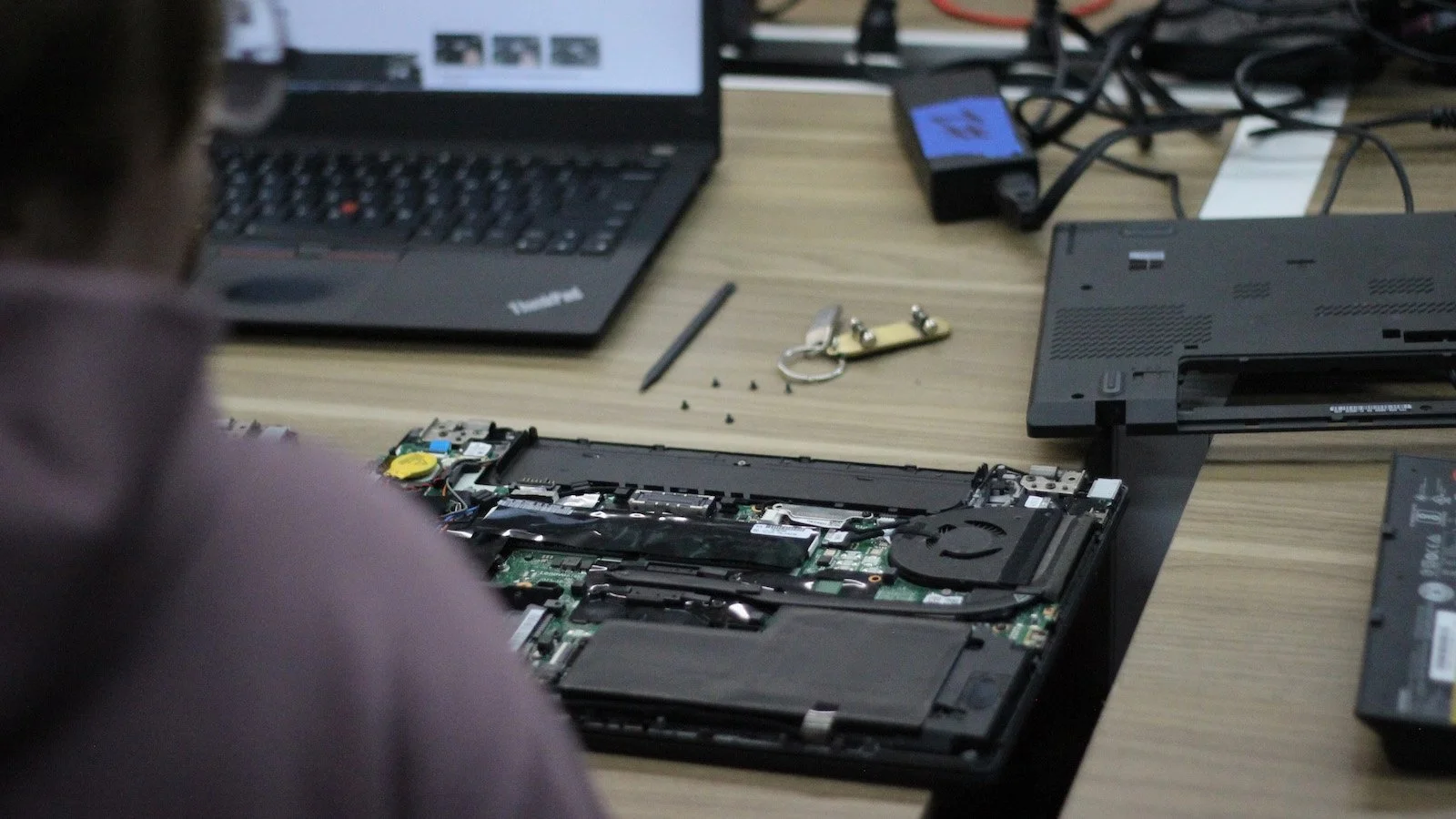
The right to repair
Everyone should be able to repair their own stuff.
Everyone should be able to repair their own stuff.
Many of the things we buy today just aren’t built to last. They break too quickly and seem designed to thwart any attempt to repair them. Oftentimes, the manufacturing company is the only option to get something fixed, and without competition, they can change an arm and a leg -- to the point it seems better to just buy a new device.
Manufacturers of everything from toasters to tractors have a clear incentive to control the repair of the products they make -- to either control the repair revenue or force upgrades. As a result we pay more and more for shorter lived devices, draining family pocketbooks and filling up landfills with unnecessary waste.
We think if you bought, you own it -- and that means being able to fix it when it breaks. We are working to address all the ways manufacturers lock out repairs by backing Right to Repair reforms across the board.
We’re a nation of people who choose consumption over repair, and it’s not because we’re lazy or wasteful. We just need companies to give us access to the parts, software and service information we need to fix our stuff.
For example, farmers who are unable to repair their tractors are reverting to using older, repairable models. We don’t want to have to haul our equipment to a dealership for every repair, we just want the chance to do it ourselves, and that means getting access to repair materials manufacturers increasingly withhold.
Repairing what we already own will save us money, reduce unnecessary waste, and give us the satisfaction of being able to reuse and repurpose something that otherwise would have ended up in a landfill.
Momentum is on our side. Right to Repair legislation has passed in Massachusetts , Colorado, New York, Minnesota, Maine, California, Oregon, Washington, Nevada, Texas, Connecticut and Kansas.. Many other states are also moving forward.
From Hawaii to Indiana, Massachusetts to Washington, Right to Repair legislation has attracted bipartisan support as a commonsense reform.
States could recover $17 billion by closing corporate tax loopholes
Corporations should pay their fair share in taxes. But every year, many large businesses are using complicated schemes to shift money earned in the U.S. to offshore tax havens to reduce how much they owe by billions of dollars.
Corporations should pay their fair share in taxes.
But every year, many large businesses are using complicated schemes to shift money earned in the U.S. to offshore tax havens to reduce how much they owe by billions of dollars.
The result? These large corporations aren’t paying their fair share, avoiding taxes their smaller competitors have to pay.
But states don’t have to wait on Washington to fix these problems. By closing loopholes at the state level, states can even the playing field and also recover billions of dollars for critical services.
From schools to paved roads and courts to public health, every person and every corporation in America benefits from government services. When it comes to paying the tab, we need to ensure that the rules are applied evenly and fairly.
But even though all of America’s businesses use these government services, not all are playing by the same rules. Instead, these corporations are avoiding taxes by moving their profits offshore -- leaving the rest of us, including small businesses, to pick up the tab in the form of higher taxes, more debt or cuts to public spending.
The good news? States can even the playing field by implementing what’s called a “Combined Reporting” system -- requiring that companies report their total domestic profits, including all their subsidiaries so that the state can calculate how much of that profit is taxable. If every state changed the way it required corporations to report on their earnings, it would close state tax loopholes and could reclaim $17 billion across the country.
And, if states take action now, not only will they make important progress toward closing corporate tax loopholes, but they will set the stage for larger, national action.
As opioid crisis evolves, anonymous company loopholes remain a gap
What has changed since our 2016 report, "Anonymity Overdose," and what hasn’t.
What has changed since our 2016 report, "Anonymity Overdose," and what hasn’t.
Our 2016 report, Anonymity Overdose, charted the connection between the opioid epidemic and the problem of anonymous shell companies.
As Congress ramps up funding for the national response to this crisis (though not at the levels some had hoped for), we wanted to provide an update on how the opioid trafficking operations are changing, and why ending anonymous shell companies is still an incredibly low-cost, bipartisan approach to help take on the opioid crisis.
Our findings from 2016
Our report, featured on CBS Money Watch, the Hill, the New York Times, the Wall Street Journal and elsewhere, made the case that ineffective money laundering controls make it easier and cheaper to traffic opioids.
We recommended closing loopholes that allow companies to be formed with no record of who owns them, which would help law enforcement seize money from drug trafficking operations, and trace street level crime up to kingpins.
The report featured 10 case studies of how anonymous shell companies -- companies formed with no record of who owns them -- were used as money laundering instruments or front operations for opioid traffickers, sometimes as part of larger more diverse criminal operations.
In the case of Kingsley Iyare Osemwengie, who sold oxycodone across many states through prostitutes and couriers, profits were shifted through an anonymous shell company aptly named High Profit Investments LLC.
In an example of how anonymous companies can be used to front as legitimate businesses, Owen Hanson allegedly led a violent international narcotics trafficking and gambling ring based in San Diego, California. He used a U.S. based anonymous shell company called Big Dog Memorabilia Inc., to disguise his activities.
From prescription abuse to more powerful street drugs
Opioids are highly addictive, and users develop tolerances which can push them into higher and higher dosages to get the same “high.” An increasing body of research is showing that prescription drug abuse can lead people to move to more powerful -- and much cheaper -- street drugs like heroin.
The National Institute on Drug Abuse, reports that “[n]early half of young people who inject heroin surveyed in three recent studies reported abusing prescription opioids before starting to use heroin.”
While a prescription drug like oxycodone might have a street value of $80 per pill, in most states, a dose of heroin costs less than a pack of cigarettes.
The rise of fentanyl, carfentanil and other synthetic opioids
Heroin isn’t the end of this chain. Synthetic opioids, which have dramatically increased in availability and popularity, can be far more powerful than heroin -- and therefore easier to move without detection.
Fentanyl, a synthetic opioid which can be 100 times more powerful than heroin, was detected in more than 50% of opioid overdose deaths in 2016, according to the CDC. The New York Times estimated that fentanyl deaths were up 540% over the last 3 years. Some synthetics, like carfentanil, are so potent that first responders risk overdose by physical contact with an addict's clothing. Carfentanil has been used as a chemical weapon.
Fentanyl poses new challenges to law enforcement, in addition to first responders and health care workers. New production techniques have spawned new distribution systems, which our law enforcement officials are working to confront.
Fentanyl by mail
Because fentanyl and other synthetics are so much stronger, they take up a lot less space and can be much more easily hidden in other products. For example, it can be hidden in fake “Silica Gel” packets and included with another product, and was uncovered by the Globe and Mail. And because these drugs are synthetics, they can be produced in factories without leaving much of a supply chain to tip off investigators.
Earlier this year, the Senate Subcommittee on Investigations did a study of how easy it was to order fentanyl through the mail -- essentially googling “buy fentanyl online” and then tracking the most responsive vendors. Researchers logged 500 online transactions with a street value of approximately $766 million. Those examples were on the standard web, there are additional portals to buy these products on the dark web, where traffic is much harder to track and trace.
The result of pressure on China by the U.S. and other countries to take more action against synthetic opioids by expanding their controlled substance bans has show some progress, but law enforcement is hoping for more action.
Last year China banned several synthetics, including carfentanil. There are indications that this has cut down on the number of sellers. Yet, while reduced, there are still open drug markets on Chinese websites. Compared to the U.S., China has loose regulation of chemical companies and fewer requirements for transparency. And while last year the U.S. Department of Justice announced the first-ever indictments of Chinese nationals accused of shipping large quantities of fentanyl through the mail to international customers, China has been reluctant to take their own enforcement actions.
Anonymous companies help ship synthetic opioids
As drug enforcement agencies catch up to some of the new methods, anonymous companies remain a gap that aids the illegal trafficking of opioids. For example, agents in Southern California intercepted a commercial pill press being sent to “Beyond Your Dreams” a shell company set up in California. The shipper was Capsulcn International, a company set up in abroad. Both are, as far as I can tell, anonymous companies.
While there is more direct to customer traffic through the mail, many order synthetic opioids to distribute. One of the reason that pill presses are an item to watch for port authorities is that a small amount of fentanyl can be pressed with other filler ingredients and made to look like oxycodone tablets, which have a greater street value. These fake prescription drugs can have very unpredictable strength and pose significant overdose risks to would-be users.
Cartels are placing their orders, too
Similar to methamphetamine, the illicit manufacture and distribution of fentanyl is lucrative for the Mexican cartels. They manufacture it in their own Mexican-based labs using precursor chemicals imported from China. Fentanyl's potency allows the cartels to deal in smaller shipments. This boosts the efficiency of its operations and results in enormous criminal proceeds.
Money laundering reforms would aid targeted new distributors
For tackling these emerging dealers, money laundering tools are critical. As was reported in “Anonymity Overdose,” following the money up from a street deal to the supplier is a time-tested investigative tool for law enforcement. Anonymous shell companies make this work all-the-more difficult by providing essentially a getaway car for drug profits.
With no record of who owns them, anonymous companies are an ideal vehicle for hiding drug proceeds. A string of shell companies can launder the money back into a usable form, which is often difficult or impossible for law enforcement to trace.
Mexican drug lords and traffickers based in China, armed with new distribution techniques frequently avail themselves of offshore shell companies. The fact that we continue to provide free harbor for illicit money increases the profit margins.
As the opioid epidemic evolves and finds new cracks in armor, getting rid of anonymous companies is one straight-forward move that would get rid of those cracks.
“Paradise for Tax Dodgers” — our response to tax bills passage
Hours after the Joint Committee on Taxation’s research revealed that the tax reform measure would increase taxes on people earning less that $75,000 in 2027, the House passed their version of tax reform.
Hours after the Joint Committee on Taxation’s research revealed that the tax reform measure would increase taxes on people earning less that $75,000 in 2027, the House passed their version of tax reform.
Fair Share’s Nathan Proctor issued the following statement:
This bill does nothing to help build an economy that works for people -- and instead rewards tax dodging companies. Though the proponents say that it would improve take home pay and boost economic growth, economists say that simply isn’t true.
Others claim it would create jobs -- but the framework would increase incentives to shift profit and operations offshore -- a point Republican Sen. Ron Johnson echoed yesterday.
It won’t do anything to make the system more fair, especially on the corporate side, where large multinational companies will be rewarded for storing cash in tax havens. Even after the Paradise Papers shed a light on the complex offshoring schemes, Congress responded by expanding those loopholes, making this bill paradise for tax dodgers.
We have big problems in our economy. The middle class is getting squeezed. Automation is reshaping work and we can’t keep up. Not only does this tax bill address none of these problems, it makes them worse, and gives away the funding that could be used to solve these problems.
Paradise Papers expose credibility problem with tax reform
On Sunday, the ICIJ announced the release of millions of documents which expose a number of tax avoidance schemes used by the wealthy and multinational corporations to avoid taxes.
On Sunday, the ICIJ announced the release of millions of documents which expose a number of tax avoidance schemes used by the wealthy and multinational corporations to avoid taxes. These revalations raise questions about the tax reform plans being debated by the U.S. House, in part because some of the influential policy voices are named in the leak, such as Gary Cohn.
Paradise Papers reveal many of the complicated schemes multinationals use to game the system when it comes to tax.
The Republicans claim their bill fixes these problems, but now we can see that many of the most influential policy voices on this bill are experts at exploiting offshore shell games.
We must allow more time to analyze the impact of provisions around offshore tax dodging to be reviewed by the public and public interest advocates. We cannot accept these new provisions, written behind closed doors by the very people we are trying to hold accountable in the tax code, without that analysis.
Even with just a couple days to review this bill, we have serious issues. Offshore profits will either be taxed at 5% or at most 10%, half the rate of smaller domestic businesses. And many of the provisions impacts have not been fully reviewed -- meaning that offshore rate could end up being lower.
Our tax code must be a level playing field for business, and this bill fails that test. The Paradise Papers perhaps explain a bit of the reason why.
Statement on Consumer Financial Protect Rule banning mandatory arbitration
Now more than ever, we need to stand up for the Consumer Bureau and keep Wall Street in check. On Tuesday, October 24, Vice President Pence broke a 50-50 deadlock in the Senate, overturning the Consumer Financial Protection Bureau’s rule banning mandatory arbitration clauses.
Now more than ever, we need to stand up for the Consumer Bureau and keep Wall Street in check.
On Tuesday, October 24, Vice President Pence broke a 50-50 deadlock in the Senate, overturning the Consumer Financial Protection Bureau’s rule banning mandatory arbitration clauses. This rule would have prevented financial firms from using small-print in contracts that prevent class action lawsuits, which make it nearly impossible for consumers without the financial resources to take on big banks.
This vote leaves all of us open to being tricked into unfair forced arbitration practices which are designed to favor Wall Street over working Americans.
At Fair Share, we’re helping people stand up for an economy that works for all of us, and where everyone plays by the same rules. We support the Consumer Bureau because it’s set up to watch out for predatory and deceptive behavior in the financial industry. But the Trump administration and many Senate Republicans are still working to restructure and even disband the Consumer Bureau which would make it more difficult to hold financial bad actors accountable.
This vote has left everyday Americans open to financial tricks from Wall Street without the ability to hold them accountable in court.
But we can’t let this vote defeat us. Now more than ever, we need to defend the Consumer Bureau, and make sure that the American people have the tools they need to take on banks and address dishonesty in the financial system.